
Asynchronous learning is full of untapped potential.
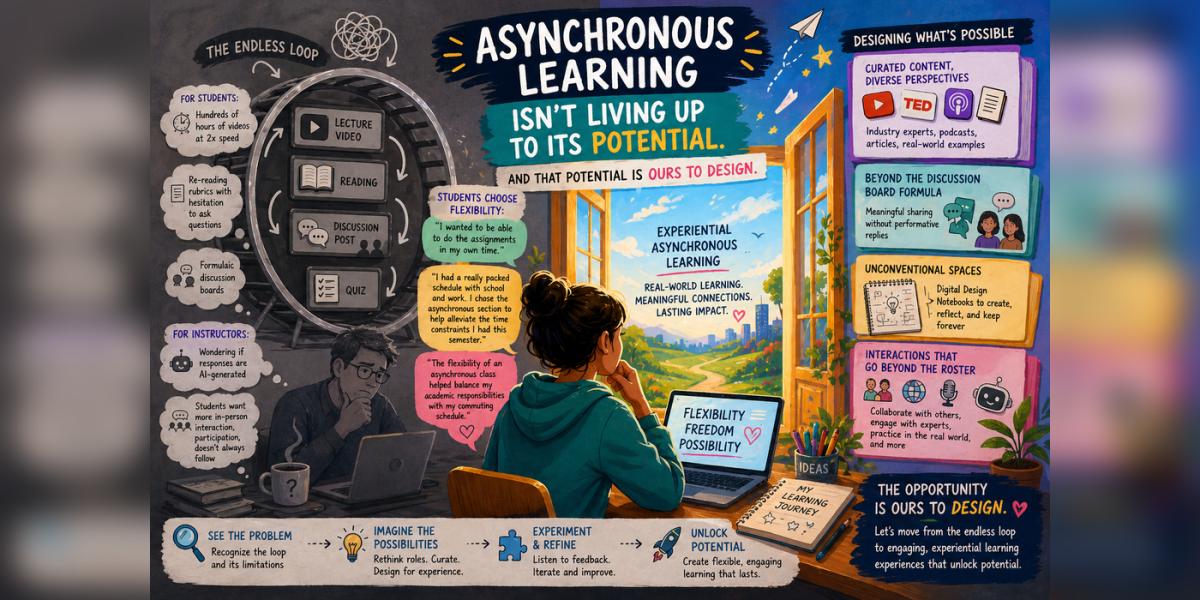
But it’s stuck in an endless loop of lecture video > reading > discussion post > quiz.
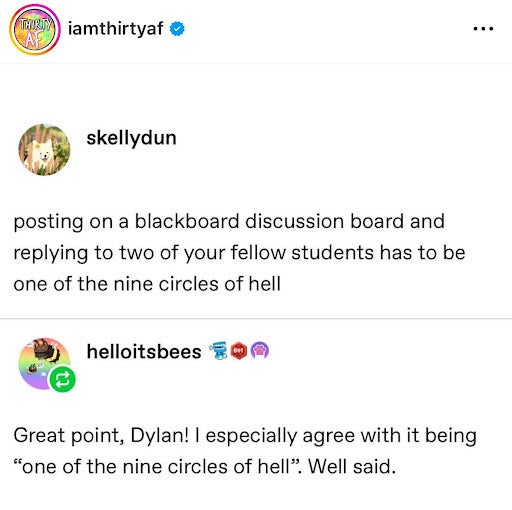
For students, it's full of formulaic discussion boards with one initial post and two required replies to your peers. It’s hundreds of hours of lecture videos played at 2x speed. It’s reading and re-reading rubrics with a hesitation to reach out to the instructor with questions.
For instructors, it’s wondering whether a student's response is AI-generated. It’s hearing students say they want more in-person interactions, where participation doesn’t always follow. It’s impersonal interactions through grades given and emails exchanged.
There’s a design opportunity here. Despite its predictability, asynchronous learning is incredibly convenient.
As a student, it’s go-at-your-own-speed learning that lets you balance education with competing life demands. It’s education without borders, allowing you the freedom to learn from anywhere with an internet connection. It’s flexibility molded in modules with to-do lists and checkboxes.
When we asked undergraduate students enrolled in the asynchronous section of IDEA201: Innovation Tools & Mindsets why they chose the asynchronous course section over the hybrid one, the answer was clear: flexibility.
- “I wanted to be able to do the assignments in my own time.”
- “I had a really packed schedule with school and work. I chose the asynchronous section to help alleviate the time constraints I had this semester.”
- “While I enjoy interacting with people, the long commutes can sometimes leave me feeling drained, so the flexibility of an asynchronous class helped balance my academic responsibilities with my commuting schedule.”
- If you’re a student, you may be looking for flexibility and will accept the annoyances of asynchronous learning in favor of it. Asynchronous learning is not going away, which means we have an opportunity to improve it.
I unexpectedly found myself with this opportunity when designing my first asynchronous course at the height of COVID; I just hadn’t realized it yet. I envisioned setting up a quiet space in my house with good lighting to record a series of lecture videos. As an experiential educator, I wasn’t looking forward to it, but after completing my master's program asynchronously, I had a model for how to do asynchronous education and wanted to replicate that.
As I was psyching myself up to be in front of the camera, I met an instructional designer who shared a different approach to asynchronous education. His philosophy asked the question: Why recreate content that already exists? He reframed the role of instructors from content creators, recording our own lecture videos, to course curators, sourcing content and resources to create engaging learning experiences for students. This shifts courses from lecture videos featuring only the instructor to a more diverse “instructional team” consisting of TED Talks from industry experts, podcasts with vibrant discussions on relevant topics, and articles with real-world examples.
As I crossed into the role of asynchronous course curator, another question emerged: What might experiential asynchronous education look like?
Experiential asynchronous learning could simply be a slight shift from what asynchronous education already is. Initially, my colleague, Dean Chang, Chief Innovation Officer at the University of Maryland, and I designed an asynchronous course, IDEA201: Innovation Tools & Mindsets, with formulaic discussion boards: one initial post and two required replies to peers. We wanted student interaction and thought discussion posts could simulate it. But after getting student feedback two weeks into the semester, we realized this formula fell short. Students shared that they liked seeing their peers’ responses because it helped them gauge if they were on the right track, get new ideas, and see that they weren’t alone in completing the course. They also shared that they didn’t gain anything from replying to each other. This resulted in us keeping assignment submissions as discussion board posts while removing the required replies. This created a space for students to see each other without wasting time on performative replies.
Experiential asynchronous learning could mean ditching traditional learning management systems in favor of unconventional spaces. IDEA311: Design Your Purpose is a design course, and designers often have notebooks. Christina Hnatov, Experience & Curriculum Designer at the Academy for Innovation & Entrepreneurship, and I wanted to give our asynchronous students that same design experience, just digitally. We found inspiration from how our colleagues were using Google Slides; not as a presentation tool, but instead as a workspace. We transformed Google Slides into a Digital Design Notebook full of interactive activities with space for students to capture their work. The notebook is the heart of this asynchronous course; it becomes a place to record ideas and reflect, and it remains with students beyond the course itself.
Experiential asynchronous learning could mean moving interactions beyond the class roster. In the Academy for Innovation & Entrepreneurship’s asynchronous courses, IDEA201 and IDEA311, we have interactive assignments where students complete course activities with family and friends, follow along with guided-audio activities to observe and try out course skills in the real world, interview industry experts, and interact with friendly chatbots to engage in interactive, guided learning activities. And, yes, students interact with each other too.
Asynchronous learning is full of untapped potential, and that potential is ours to design.
Exploring what experiential asynchronous learning could be can open possibilities. Being willing to experiment and get feedback on ideas can move it from the endless discussion board loop to something better.