
Recently I had the honor of participating in a panel during the 3rd annual TerrapinSTRONG symposium here at the University of Maryland. The topic of this year’s symposium was Navigating Change: Turning Disruption into Direction, and the panel I participated in was titled Building Capacity: Supporting Ourselves & Others through Change. While preparing for that panel, I realized I have a lot to share about this topic — more than we had time to discuss during the symposium! So here we are.
First, a bit about the context I’m coming from — in case you’re not familiar. I lead the Academy for Innovation & Entrepreneurship here at the University of Maryland. We introduce design and innovation approaches to students, staff, and faculty across campus to build their capacity as innovators and creative problem solvers in their field. We’re really good at helping groups think differently about their work by coming up with and trying new ideas.
When I talk about design, I don’t specifically mean fashion design or interior design. In our work, design is a more general practice and approach to working and collaborating characterized by three things:
- Human-centered — We seek to learn from and build with stakeholders.
- Open to possibilities — We frame opportunities in new ways and generate many possible solutions.
- Experiment-driven — We test new ideas early and often.
In my experience, design can help us navigate change in a couple of key ways: first, it can help navigate the emotions of change, and move from unproductive to productive moods. And once our teams are emotionally ready, design can help us look toward the future and both generate and explore possibilities. I’ll share more about these below, along with a few tools you can try out, including a few tips for leaders leading teams through change.
I. How can design help us navigate the emotions of change?
Personally, I tend to approach uncertainty and moments of transition with cautious optimism. In fact, I’m probably a little more optimistic than most. I grew up with the privilege of frequently living in and visiting other countries for long periods of time, so it’s probably the case that my over-exposure to change and uncertainty helped shape my attitudes toward it. I have a very future-oriented, opportunity-driven worldview. In a world with some people who see a glass “half-full” and others who see a glass “half-empty,” I see a glass and think: “Oh! What if we draw a cute little monster wearing a swimsuit on the side of the glass so that it looks like we’re emptying the monster’s swimming pool each time we take a drink?” I’m well aware that my playful optimism can be extremely off-putting — especially if the circumstances are especially dire and are causing an intense amount of stress, anxiety, or other negative emotions to take hold. This is where design comes in.
Design Strategy #1: Make space for emotions.
One of the core tenets of design is: Seek to learn from others. Rather than leaping to optimism and opportunities (and expecting everyone else to be able to take the leap with me), I need to make some space for the feelings to emerge and be felt — both my own feelings and those of the others around me. Design reminds me to be curious about what is going on with others around me.
Begin first by noticing your own feelings with respect to the uncertainty or change. How am I feeling? And being curious. What’s driving this feeling? Then, start to notice how others are doing with the change or uncertainty. This will probably mean you ask them either one-on-one, or while gathered as a team. How are you feeling about all the change? From there, follow your natural curiosity as people share. Acknowledge their experience. Notice similarities and differences amongst your team. Perhaps some similarities you notice are the things you want to tackle together first.
With my own team at The Academy, I try to make space for people to share what’s on their mind and especially how they’re feeling. We create space in our working sessions and team meetings for individual reflection, and then as people are comfortable, we share some of our reflections as a team.
Design Strategy #2: Move from unproductive to productive moods.
In addition, notice your own moods while working or collaborating on something. If you find that you’re in an unproductive mood (e.g., anxiety, boredom, frustration, impatience), experiment with ways to make an active shift toward productive moods (e.g., confidence, trust, wonder). Simply noticing your own moods makes it more likely you can try to make the active shift from unproductive to productive. (To learn more about moods and learning, I recommend Learning to Learn and the Navigation of Moods by Gloria P. Flores.)
Here are two example exercises that can help a team shift from unproductive moods to productive moods:
- “What is on your mind? What is distractingly on your mind?” Team members respond to those two questions on post-its, and we share and discuss. Post-its are powerful because they allow for a high volume of ideas, conciseness and semi-anonymity in the work. As the team comes together to share, we group similar post-its together on a whiteboard and trends start to visually emerge. The results of this share-out guide what we address first. As the leader of the group, try to identify small things that can be tackled first in order to help people feel more ready to tackle bigger challenges later.
- Rant, Spew, Proffer. A friend of mine designed and led this process right after the 2016 election. The idea is you literally give people bounded time to rant (through writing), then share with a partner (spew), and finally proffer (decide which insights you’d like to share with the larger group). Once people share the insights that came out of the conversation with their partner, people can work together to create “how might we” questions to carve out opportunities or areas that they are excited to tackle together (thus, the “we” in the question stem).
II. How can design help us identify opportunities for change?
Let’s take a step back and look at the contexts in which we were raised and educated. Ambiguity and wrestling with uncertainty are things we often try to minimize during childhood, both in and outside the classroom. Parents regularly try to simplify the path for their kids. We as educators tend to simplify assignments and make things feel more linear and more clear. Instead, we should be baking ambiguity INTO learning experiences with intentionality.
Mindset Shift #1: From tolerating ambiguity to embracing it
Find ways to create a mindset shift from uncertainty being a thing to be tolerated to a thing to be embraced or even leveraged. In design, the ability to navigate ambiguity is the meta ability that we as designers are all aiming for! (And as design educators, it’s what we hope to unlock in our students.) The good news about this ability to navigate ambiguity is that it’s a thing we can get better at! It’s not a fixed trait — it’s something we can learn to be more comfortable with and even embrace.
Many innovation tools and mindsets can equip people to better navigate uncertainty, change and ambiguity, including:
- Focus on questions. When working on a complex challenge, bias toward generating new questions at first rather than a “need for closure” — a need to come to a nice, neat answer immediately. When you rush to clarity or a single answer, you decrease the possibility for new breakthrough ideas to emerge.
- Defer judgment. When you’re coming up with ways to address a challenge, aim to suspend judgment and generate lots of creative ideas at first — even ones that might not be immediately feasible. (“Yes, and!” is a key design phrase to lean on.)
- Experiment with new ideas. Explore and test multiple rough ideas at once, rather than identifying one single solution to perfect and focus on.
- Seek out multiple viewpoints — especially conflicting ones! We have a tendency to seek to validate our ideas, rather than challenge them; however, opportunities are hidden in areas of tension. Go out and find the people that might have a different perspective. These conversations might lead to new ideas or a better way to frame a problem.
Mindset Shift #2: From “The future is happening to me!” to “I can shape the future!”
To help move your team (and maybe yourself!) from a passive to an active stance, engage in some imaginative future-shaping. In other words, now that X is gone or Y has changed, let’s imagine the many possible futures or outcomes.
There is a favorite tool that we have at The Academy — the Futures Wheel. Here’s what that looks like in practice:
1. Take a topic — we often use “school” as an example — and you brainstorm what a school MUST have: classrooms, textbooks, teachers, etc.
2. Now, take one of those things that your topic MUST have and try to imagine a future WITHOUT that thing. What would happen? What would all the possible positive and negative implications be? Build a visual mind map of all the positive and negative implications you can think of. It’s helpful to also think about 2nd, 3rd and even 4th order possible implications.
For instance, here’s an example thread of implications from the schools example — let’s say we’ve chosen “classrooms” as the thing that no longer exists:
No classrooms → It’s noisy inside the building! → The learning moves outside → Mobile classrooms become a thing → Instead of food trucks, there are learning trucks → Students engage the local community in what they are learning with pop-up activities around the city
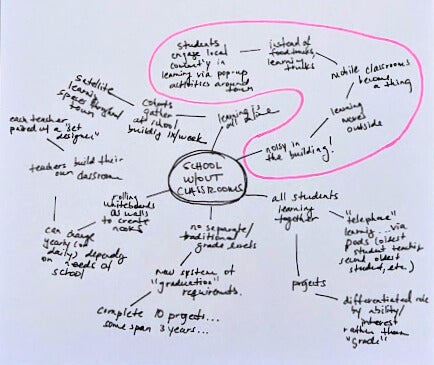
3. Next, take a step back to notice. What are the positive implications that you’re most excited about? Are there small ways to start to experiment with some of the most exciting elements of that future?
The key to this activity is to not set high expectations. In other words, there shouldn’t be an expectation that if we spend 30 minutes with a Futures Wheel, out will pop the perfect and most efficient solution. Engaging with future-shaping is more like throwing a football around or getting into the music studio for a low-key jam session. We have found that it’s much easier for people to engage and lean into generating imaginative possibilities if there’s not too much riding on it. As this muscle develops and people feel more confident, it can be used in higher stakes projects and challenges.
III. What else can leaders do to navigate change?
Get on the same side of the table with your team. This means shifting your stance from someone that has all the answers to someone that can guide the team’s collaboration process. When my team shares how we’re doing or imagining where we’d like to grow toward, there isn’t an expectation for me as the title-carrying leader to fix things. The conversation is centered around how WE as a team can affect the change that is happening, and everyone is involved in designing and shaping what’s next. I will often take the lead on doing some “in-between” work that needs to happen, such as synthesizing ideas or observations and doing what I can to move experiments forward. Then we come together again to share, think, generate ideas and plan.
Furthermore, open up yourself to forming deeper connections with your team. With my own team, I often share what worries me, and I balance that with creating moments of play. We set aside time to do things as a team that reinvigorate us and remind us of WHY we are here. Instead of a holiday gathering or party, we celebrate “Favorite Things Day” every December. We design a day of doing things together that we love to do and are tangentially related to our work. It just so happens that since we are all designers and makers, most of our activities involve hands-on MAKING. This annual tradition has helped us rediscover one of our core talents as a team — helping people MAKE ideas happen — and in turn we’ve been leaning more into that in our work.
And finally … seek out collaborators! I have a good friend that has a post-it on the center console of her car that reads: “Today will be as great a day as you make it.” She’s had it there for years. And when it’s gotten crumpled and dingy, I’ve noticed that she’s re-created it. I think of that post-it often, and it’s especially relevant in times of change and uncertainty. Today will be as great a day as you make it. And in those times when you need a creative collaborator to help you make space for emotions, and then begin to shape the future, stop by ESJ 1130 — The Academy team will always be ready to listen and say “yes, and!”